Free UK Delivery on orders over £99

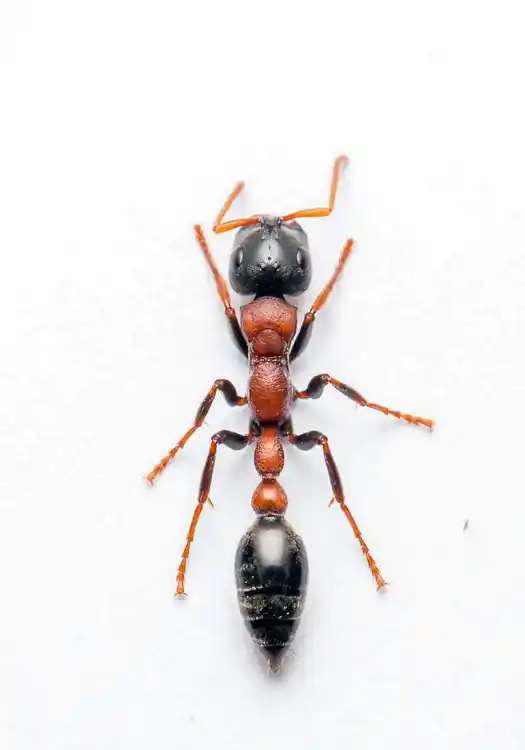
Tetraponera rufonigra
Bicoloured Arboreal Ant

🐜 At a glance
Origin: 🌏 South and Southeast Asia
Keeping level: Expert — fast, fearless and with a sting more painful than a wasp. Adults only
Queen: 12–15mm; queens live around 2 years
Workers: 10–12mm, black head and gaster with a pale orange-red thorax
Colony form: Several queens (polygyne), around 10–12 per colony; 100–200 workers in captivity
Nest temperature: 24–28°C (outworld 21–30°C)
Nest humidity: 70–80% in the nest; outworld 60–70%
Workers before moving into a nest: 10+
Winter: No hibernation — active all year
📖 About this species
A huge, slender arboreal ant that runs straight up tree bark and hunts alone rather than in groups — amazing to watch, but with a very painful sting. It attacks only live prey, so never offer dead insects. A natural ant farm suits it best. We have kept them for 2 years: from a single queen and 21 workers to 107 workers.
⚠️ Sting: a very painful sting, more potent than a wasp's. Adults only — never handle the ants, use long tweezers.
📦 When your ants arrive
⚠️ MOST IMPORTANT: leave the parcel completely unopened, exactly as it arrived, at room temperature for 5 hours. The ants must adjust to your home’s temperature gradually — abrupt temperature changes make ants seriously unwell.
After the 5 hours, check the queen is safe and sound, then leave the colony in its original packaging (test tube still in its tin foil and wrapping) in a quiet spot — in daylight, never direct sunlight — away from vibration and daily household activity.
😴 Give the colony 4 to 5 days of complete rest. The ants were fed before dispatch and need nothing from you during this time. Assemble and water the nest while you wait.
Still workers or a motionless queen after delivery are almost always delivery stress. Check the antennae: moving antennae means she is fine. Almost all recover within 4 to 5 days (a little longer for bigger queens).
Do not remove the black divider inside the test tube (between the two cotton stoppers) — it keeps the ants safe in transit. It has a hole, and the queen and all workers pass through it without any issue.
👑 Start with a colony, never a lone queen: choose at least 10 workers with eggs, larvae or pupae laid inside that colony — that is your proof of a fertile egg-layer. The more workers, the better your chance of success.
🏠 Moving into the ant farm
Keep the colony in its test tube until it has at least 10 workers. Moved earlier, the workers often abandon the queen in the larger space, which can lead to colony failure.
Connect the test tube to the nest with the delivery tin foil still on and leave it for 14 days. Then slide the foil back about 1mm every day until the tube is fully exposed to daylight.
If the ants have not moved in 2 days after the tube is fully exposed, wrap the foil back on, wait another fortnight and repeat the whole process — patience is the key. Moving in happens on the ants’ own time: anywhere from a couple of days to 6 months.
The red filter and black cover stay on the nest at all times — it is pitch dark inside. The black cover can come off once a day for 2 to 3 minutes (ideally at night); the red filter once a week for 2 to 3 minutes.
☀️ Place the ant farm in normal daylight, never direct sunlight (the sun can overheat a nest within minutes). Avoid windows, radiators and heaters, vibrating surfaces, speakers and TVs, strong smells such as the kitchen, and busy walkways. Keep a steady room temperature.
🍯 Feeding
🦗 Live prey only — this species attacks living insects and ignores dead ones. Offer baby crickets or small locusts 2 to 3 times a week, in the outworld only, sized so a single worker can overpower them.
🔍 Buy live food only from a clean, trusted breeder and check it for mites before it goes in — mites can destroy a colony, starting with the queen.
🍯 Offer a small drop of organic ant honey or Best Ants UK Ant Nectar alongside the prey. Never sugar water.
🧹 Remove leftovers and uneaten prey after 2 days to prevent mould.
💧 Watering the nest
💧 Use distilled or purified water only — never tap, rainwater or bottled mineral water, even boiled. They carry minerals and microbes that turn a nest green with mould. A litre of distilled water costs a few pounds and lasts over a year.
Water the nest with the pipette provided: pour slowly, a few drops at a time, through the watering hole, and stop as soon as 1 or 2 drops appear inside the nest — that is how you know it is done correctly. More than that is too much.
Once a week is usually right — slightly more in summer, less in winter. Never water the outworld.
🌡️ Temperature and winter
🌴 No hibernation. Tetraponera rufonigra comes from a warm climate and must stay at 24–28°C all year round — in a UK home this means gentle heating in the cooler months.
Use the Advanced Heating System Small 4W warming no more than a quarter of the nest, on the side opposite the water inlet, so the ants can choose their temperature. For a colony still in its test tube, use the Heating Mat with Thermostat Small 4W and heat only about 25mm of the tube, at the end opposite the water — never lay the whole tube on the mat.
Never let the colony get cold, and never expose it to abrupt temperature changes.
🤩 Did you know?
Unlike most ants, which hunt in groups, each Tetraponera worker stalks and attacks its prey alone.
In parts of Southeast Asia it is considered a pest because of its painful sting.
⭐ Golden rules | Never break these
🚫 Never put ants in a fridge, and never expose them to abrupt temperature changes. Cold does not kill a colony instantly — the ants get sick and die over the following days — and prolonged cold near freezing damages the sperm a queen stores from her nuptial flight, so she may never lay fertile eggs again.
🚫 Never use gel ant farms, Ytong or concrete nests, or DIY nests.
🚫 Never use tap, rain or mineral water, even boiled.
🚫 Never move a colony into a nest too early, and never tip or shake ants out of their tube.
🚫 Never disturb the colony with tapping or handling — vibration stresses the queen and she can stop laying or eat her eggs.
☀️ Never keep the farm in the dark: ants need daylight for their circadian rhythm. Daylight yes — direct sunlight never.
🧤 Never handle these ants or let children handle the setup — always use long tweezers and keep the lid closed and the PTFE band fresh.
🚫 Never release this species into the wild — a colony raised in an ant farm would not survive. If you can no longer keep it, visit our ants adoption page and ask us whether we can adopt it.
🛒 Recommended for this species
📚 These care notes cover the essentials only. Please read the full ant farm setup guide and Tetraponera rufonigra product page from A to Z. Questions? Message us through our contact form and we will be happy to help. 💚
Written and reviewed by the Best Ants UK team, keeping ants since 1997.