
How to Care for Florida Carpenter Ants | The Ultimate Beginner's Guide
Updated: 5 days ago

📋 Prefer the short version? Download the free Camponotus floridanus care sheet — every key figure from this guide on two printable pages.
Key Takeaways
A secure setup, a balanced diet and a low-disturbance routine help Camponotus floridanus colonies thrive for years. Here is what to keep in mind:
Start your queen in a covered test tube with water behind cotton. Move her to a modest, expandable nest only when colony growth makes feeding difficult.
Keep the nest at 24–28°C (75–82°F) with a 50–70% humidity gradient, purified water, airflow and secure PTFE barriers to prevent stress, mould and escapes.
Feed workers a small drop of organic honey for energy, plus protein jelly or pre-killed feeder insects two to three times a week for brood development.
Remove leftovers within 24–48 hours. Inspect weekly for waste, drying reservoirs, mould, failing barriers and unusual worker deaths.
No cold hibernation. This subtropical species never needs a cold winter; an optional mild rest at 18–20°C (64–68°F) for 2–4 weeks is enough.
Are you fascinated by large, fast-moving, strikingly bicoloured ants? Florida carpenter ants are exactly that. A mature colony can reach 10,000+ workers, and watching one develop from a single queen is genuinely rewarding.
So, what do carpenter ants look like? What does a Florida carpenter ant look like? How big do they get? We will answer all of that. This guide covers Camponotus floridanus, the Florida carpenter ant queen, setting up a secure Florida carpenter ant nest, what to feed carpenter ants, and how to take care of carpenter ants properly. You will also learn how to avoid a Florida carpenter ant bite and keep a colony of the giant ants Florida keepers love. Let's get started!
Meet Florida Carpenter Ants | Camponotus floridanus
Knowing how this species lives and how large it can grow shapes every decision: nest size, feeding schedule and observation routine. So, before anything else, let's get to know Camponotus floridanus properly.
What does a Florida carpenter ant look like?
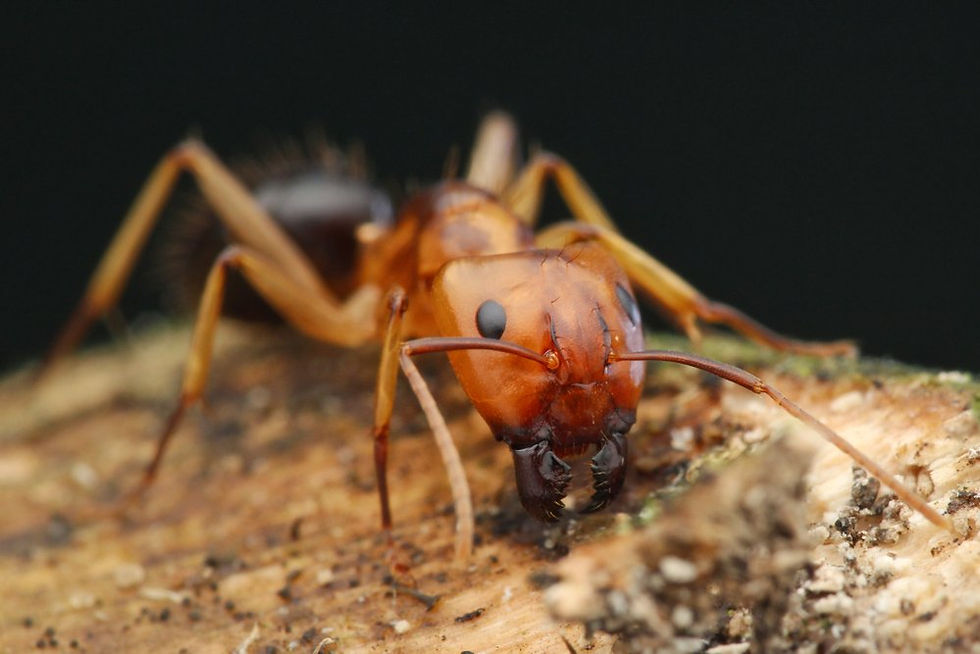
Camponotus floridanus is hard to miss. Their bodies are bicoloured. The head and thorax range from ash brown to rusty orange, while the shiny gaster is jet black. Long golden body hairs add yet another striking detail. Look for elbowed, 12-segmented antennae without a club, one narrow waist node, and an evenly convex thorax in side view. This profile quickly separates them from termites, whose antennae are straight.
One more thing worth knowing: Florida carpenter ants have no stinger. They defend themselves by biting and spraying formic acid. Handle them with care.
Florida carpenter ant size | Queens, minors and majors
Worker size varies quite noticeably within a single colony. Minors measure 5.5 to 7 mm, while majors reach 8 to 10 mm. Winged females, known as alates, can reach up to 20 mm.
Did you know the Florida carpenter ant queen raises her first brood entirely alone in a sealed chamber? She sheds her wings after mating and relies on her body reserves until her first workers eclose. Those early workers then take over: foraging, feeding and grooming the queen, maintaining the nest, and caring for new brood. The complete egg-to-adult cycle takes 50 to 70 days.
Natural habitat, night activity and colony growth
Florida carpenter ants nest in dead branches, logs, stumps, soil beneath objects, rotting wood and even soft Styrofoam. They do not eat wood. They simply use these spaces for nesting.
Most foraging happens just before sunset, continues until two hours after sunset, and picks up again around dawn. Laboratory colonies show higher feeding and foraging activity at night than during the day, so placing food where it can be checked in the evening makes inspections far easier.
Colonies grow from eggs through larvae and pupae into adults. Mature populations commonly reach 4,000 to 10,000 workers, and queenless satellite nests may form anywhere from 6 to 30 metres from a mature nest. This is a species that genuinely grows into something impressive.
Check local rules before getting a queen or colony
Always check the regulations for your location before collecting or purchasing a carpenter ant queen. Rules on moving ants between states differ, so if you are in the US, buy only from a US seller holding a USDA permit. Trust the professionals.
Fascinating Facts About Camponotus floridanus
This is not just a hobby ant. It is one of the most studied ants in the world.
In 2010, Camponotus floridanus had its full genome sequenced for the first time, alongside the Indian jumping ant, in a study published in Science.
In a study published in Science in 2016, researchers treated young majors with a compound that alters the chemical tags on their DNA packaging. The big soldiers began scouting and foraging like minors, and the change lasted up to 50 days.
Every Florida carpenter ant carries a partner bacterium, Blochmannia, living in special cells between its gut cells and in the ovaries of females. It supplies essential amino acids and may help recycle nitrogen, upgrading the ant's diet from the inside.
Step 1 | Set Up a Safe Florida Carpenter Ant Nest
A good nest setup makes everything easier. Get this right before you introduce a Florida carpenter ant queen or any workers, and you will avoid most of the common problems beginners face.
Gather your basic ant-keeping supplies
Here is what you need before anything else:
A clean test tube and untreated cotton
Mineral, distilled or purified water and a dark cover for the tube
A thermometer and a thermostatic heat mat or cable
A small feeding dish, tubing and a lidded outworld
Check that every connector fits before you bring any ants home. Gaps you miss now become escape routes later.
Use a test tube for a queen or small colony
A founding Camponotus floridanus queen does well in a simple test tube setup. Purified water sits behind a firm cotton plug at one end; the dry side becomes her chamber. The entrance cotton allows airflow without exposing her to disturbance. Cover the tube, keep it stable and leave her to it. Most keepers transfer at roughly 10 to 20 workers, so there is no rush to move her earlier.
Choose a nest and outworld that fit your colony
Once the colony outgrows the tube, connect a modest acrylic, glass or gypsum nest to a separate outworld. A young colony needs only a few chambers. An oversized display at this stage actually stresses them. Colonies commonly move into a formicarium after reaching 50 to 100 workers, so choose an expandable setup from the start. Keep the outworld dimmer and less inviting than the nest itself.
Set a safe temperature with a heat gradient
Heat one side of the nest only. This gives workers and brood the freedom to choose their preferred position. The nest should sit around 24–28°C (75–82°F), with a warm spot available up to 30°C (86°F). Direct sunlight or heating the whole enclosure takes that choice away entirely.
Provide nest moisture, drinking water and airflow
Create a moisture gradient inside the nest: one damp area, one drier area. Around 50 to 70% humidity suits this species well. In the outworld, keep a water tube or water dispenser topped up at all times with mineral, distilled or purified water, never tap or rainwater. Avoid flooding chambers. Fresh airflow is equally important; it limits mould and disperses formic acid before it builds up.
Secure lids, tube connections and escape barriers
Florida carpenter ants are strong climbers. Test every lid, port, mesh and tube connection before introducing them. Apply a thin, even band of fluon or PTFE along the inside of the outworld walls. A well-applied band lasts six to 12 months before it needs reapplication. When inspecting seams, judge any gap against your smallest worker, not against the larger majors.
Step 2 | What to Feed Your Florida Carpenter Ants
A ready nest is only half the job. Now, let's talk food.
When to start feeding a founding queen's colony
Leave a newly mated Camponotus floridanus queen completely undisturbed until her first workers appear. These queens found claustrally, meaning they rely on their own body reserves to raise the first brood. Placing food near her too early only creates mess and unnecessary disturbance. Once workers are active, place all food in the outworld, away from the brood.
Organic honey for energy
Offer a small drop of organic honey, on its own or lightly diluted with purified water, in the outworld. Carbohydrates keep your adult workers active and energetic. Simple. Effective.
Protein for brood development
Protein jelly is the easy, mess-free protein option.
Pre-killed feeder insects (frozen, then thawed) such as fruit flies, mealworms, crickets, roaches or waxworms all work well. Never offer live insects.
Larvae depend on insect protein for development, and the queen needs it to keep laying.
Offer protein portions two to three times a week for small colonies.
Keep portions small. A drop of honey and one worker-sized insect piece is plenty to start. As the brood grows and food disappears quickly, increase gradually.
Remove leftover food promptly
Remove uneaten insect food within 24–48 hours. Leftovers attract mould fast, and mould is one of the most common problems in any ant setup. A quick check each day keeps the outworld clean and your colony healthy.
Step 3 | Keep Your Colony Healthy and Tackle Common Problems
A well-kept colony is a happy colony. Simple, regular checks are all it takes to stay on top of things without disturbing your workers.
Follow a simple cleaning and inspection routine
Once a week, clear out waste, top up water and check your PTFE barriers. Look out for frass, wood shavings, dead ants or leftover food. Catching these early keeps your colony stress-free and your setup clean.
Track brood growth without disturbing the queen
Check on brood progress while you are already feeding. Take a quick look, then cover the nest again. Healthy brood moving through its stages is a great sign. Full development runs 50 to 70 days, so patience is key here.
Respond to mould, drying out or worker deaths
Mould? Remove food immediately, improve airflow and move the colony if needed.
Reservoir dried out? Attach a fresh water setup straight away.
Workers dying? Record numbers and conditions. Change one thing at a time and observe.
Do not panic. Most issues have a simple fix once you identify the cause.
Understand winter slowdown without forcing cold hibernation
Unlike European and northern American Camponotus species, Camponotus floridanus is subtropical and does not undergo true hibernation (diapause). Never put the colony into cold hibernation, such as a cold garage at 8–12°C (46–54°F), as this will harm or kill it.
In Florida, wild colonies experience short, mild winter dips when activity and egg-laying temporarily slow down. You can recreate this by lowering the temperature to 18–20°C (64–68°F) for 2–4 weeks, which can help reset the queen's laying cycle. Lower and raise the temperature gradually over several days to avoid thermal shock, and keep offering food and water throughout.
This rest is optional. In captivity, you can also keep the colony at its normal active range of 22–26°C (72–79°F) all year round with no cooling period.
Expand the nest when the colony needs more room
Watch for crowding around the nest. When cleaning becomes difficult or workers seem restless, it is time to add space. Connect a new nest and let the workers move brood across at their own pace.
Avoid a Florida carpenter ant bite during care
Use a container or forceps when moving workers. Never handle them directly. They bite and can spray formic acid, though they carry no stinger. Respect their space and they will rarely cause trouble.
Keeping This Species Outside the US
Native US species are not legal or available to buy everywhere, so check your own country's rules first. In the UK, buy only captive-bred or legally imported stock from a reputable seller. The good news for UK keepers: we stock Camponotus floridanus ourselves, supplied legally and ready to ship. Pair your colony with our Carpenter Ant Farm Starter Kit, built for Camponotus, and add the Advanced Heating System Small 4W to give this warmth-loving species the gradient it needs in a cooler British home. Prefer to compare first? Browse all our carpenter ants.
Conclusion
You can keep Florida carpenter ants healthy by providing a secure, properly sized nest, steady warmth, purified water, organic honey and suitable protein. Regular inspections, careful cleaning and gradual expansion help the colony grow without unnecessary stress. Handle workers cautiously and respect their space. With patience and consistent care, your Camponotus floridanus colony can become an active, rewarding colony to observe for years. After 30 years of keeping ants, we still find Florida carpenter ants one of the most striking species you can watch grow.
FAQs
Q1. What kind of nest do Florida carpenter ants need?
A founding queen or small colony can live in a covered test tube with purified water held behind cotton. As the colony grows, connect a suitably sized nest to a secure feeding area, called an outworld.
Q2. What should I feed Florida carpenter ants?
Once workers appear, offer a small drop of organic honey for energy, plus protein jelly or small portions of pre-killed (frozen, then thawed) feeder insects for protein. Feed protein two to three times a week and remove leftovers within 24–48 hours.
Q3. What temperature and humidity do Florida carpenter ants need?
Keep the nest around 24–28°C (75–82°F) with roughly 50–70% humidity. Heat only one side and provide both damp and dry areas so the ants can choose comfortable conditions.
Q4. Do Florida carpenter ants need to hibernate?
No. They are subtropical and do not undergo true hibernation, so never put them into a cold winter. You can give an optional mild rest at 18–20°C (64–68°F) for 2–4 weeks, lowering and raising the temperature gradually over several days, or keep them at 22–26°C (72–79°F) all year round.
Q5. Can Florida carpenter ants bite or sting?
They can bite and spray formic acid, but they have no stinger. Avoid handling them directly; use a container or forceps when moving them.


